Showing posts with label budget travel. Show all posts

July 8, 2010

A Hook, a Fish Line and an Air Mattress: Improvised fishing with the kids in Negril

I am very happy with my daily routine in Negril this summer. For me, this routine involves happy writing each weekday morning, then having lunch with the family, and going to the beach in the afternoons. Being able to swim in transparent waters every afternoon is blissful for me. I have not missed a day at the beach in the six weeks we have been in Negril. Even when it rains, I will at least go for a long walk by the sea when the rain clears.

My three kids, however, have decided that they need more entertainment than simply going to the beach. Their morning routine starts with home schooling for two hours with their tutor, then playing in the yard with their friends until lunch is ready. There are two small children who live in front of us and they often catch butterflies or other small creatures together. My daughters also love to help our neighbor herd his goats and take them out for grass each morning. After lunch, they play video games, read, or play outside or inside. When I ask if they are ready to go to the beach, they often claim they do not want to go. Without exception, they have fun when we get to the beach; so, often the trick lies in getting them there.

Our latest “trick” is the promise of going fishing. The first time the girls went fishing, it was with some friends who invited them to go on a boat early in the morning. That boat trip costs US$50, so that was the only time they did that. Instead, now we rely on my husband, Fernando’s ingenuity, and the kids can go fishing whenever they want, practically for free. This is how it works.

Fernando buys some hooks and fish line for a few cents at the hardware store. They go to the nearby beach and look for sand crabs and snails for bait. Nando sets up the rudimentary hook, line and sinker. Then, he paddles the girls out on our air mattress to where the fish are. We have one of those inflatable air mattresses, and it works great as a raft! (You can see our fishing equipment in the photo behind us!)

The girls put on their face masks which allow them to see the fish underwater. Tatiana and Soraya – my nine year old twin daughters – love fishing like this. You can see when the fish begin to nibble at the bait. When you see them nibbling, you just pull a bit, and there you have a fish. When the girls catch a fish, they yell out in excitement. Nando pulls in the line and puts the fish into a plastic bag that he keeps on the raft. Then, the girls go back in for another fish.

The other day, they caught sixteen little fish, giving us plenty of fresh fish for dinner. The fish are small – so it is quite a bit of work to clean and de-scale all of them. But, it is definitely worth it to have the tasty, fresh fish. Plus, it is our best way to get the kids out of the house - for now, at least. I am sure that soon they will become bored with this and we will have to find a new way to entertain them soon.

May 31, 2010

Negril, Jamaica: Sea, Sand and Fun

We have been in Negril, Jamaica for nearly a week now.

We are staying in an inexpensive cottage called Silver Star. It is located a fifteen minute walk from the famous Seven Mile Beach and a five-minute walk from a smaller beach that is great for snorkeling. As someone who loves to be able to walk to the beach and on the beach, this is fantastic.

The accommodations are quite modest, but they are clean and comfortable, so we are happy. The small size of the cottage just means that we have to make sure and keep it tidy and keep everything in its place.

It is very hot here in Negril so we take advantage of the relatively cool mornings to do work and do household tasks. I spend my mornings writing in my office (whish is just a separate hotel room) and the children are doing their schoolwork in the mornings. We have hired a tutor to give the girls lessons, and that is working out great so far! After lunch, we are all free to spend the afternoons as we like.

Of course, most days we go to the beach. If you can believe it, some days the kids complain about going to the beach. Mostly, they are not keen on the 15 minute walk in the hot sun. However, once we arrive at the sea, they have a blast.

The first day we got to Negril, the sea was amazing. It was absolutely transparent, even up to about 30 feet deep. Snorkeling in that water was fantastic. However, the next day it rained and the water has not been the same since. There are two reasons for this. One reason is that when it rains the sea gets more turbulent and brings the sand up into the water, making it less transparent. The other, less pleasant, reason, is that the rain means that the muddy, dirty river water gets into the sea, turning it a brownish color.

We have found thus far that we can walk or take a taxi about another mile down the beach - away from the river - and get to the clean part when the river comes into the sea. Hopefully it will not rain much and we can enjoy the transparent water once again. Honestly, this year, after seeing so many amazing beaches, we are getting harder to please!

None of the beaches we have seen so far in Negril have any waves to speak of. The girls complain that this makes it boring. However, it also makes it easier for us as we do not have to worry about the girls being pulled out to sea. Yesterday, I went snorkeling with Tatiana and Soraya - my nine-year old twin daughters - and we were able to get pretty far out without me being worried. However, as it was our first time, I did not stay too long. I was worried they (or I) might get tired.

I am looking forward to spending the next two months in Negril, and, slowly but surely, getting to know the rest of the Seven Mile Beach.

February 9, 2010

The Children’s Museum in Santo Domingo: Lots of learning, less fun

The Children’s Museum in Santo Domingo is a worthwhile trip if you have small children, but don’t count on spending the whole afternoon there. The museum consists of a guided tour that does not last more than an hour. The Museo Infantil Trampolin's motto is "Where learning is fun," yet the focus is more on learning than on fun.

Last Saturday, I took my daughters – eight-year old twins and a six year old – to the Children’s Museum in the Colonial City. We found the museum to be more focused on learning than on play, but enjoyable nonetheless. Instead of being a free play museum as in other cities, it is actually more of a guided tour through a series of rooms.

The first room involves a large a large-screen film about the solar system. Each of the other rooms is similarly educational. The room about natural disasters had an earthquake simulator, which the children enjoyed. They also liked the room with the dinosaurs, especially the game where you try to fit the dinosaur fossils into the holes in the wall.

Luckily, however, the tour is less than an hour, as the children began to get a bit antsy towards the end. The last room (pictured left) is the only one where the kids can engage in free play. After about ten minutes, however, the tour guide suggested our tour was over, as the next family was coming through. I asked if we could stay while the next family came in, and he consented.

This last room has a hopscotch design on the floor, a pretend hospital, a make-believe store, a pretend school, and lots of other great things for children’s imagination. When the tour guide asked us to leave a second time, I didn’t protest, although I did think that they should let people stay in that last room as long as they wished. All those wonderful toys and little rooms go to waste if kids can’t play in them and let their minds run wild.

When we left the museum, we were not quite ready to hop in a taxi back home. Just to the left of the museum is Fort Ozama. This is a great place to take kids who like to run around. First, we explored the huge fort and imagined what it must have been like to ward off pirates approaching in the sea. Then, we came back to the ground, and the girls had fun climbing on the various cannons.


The girls made friends with other children that were there playing, and played for a long while on the grass and on the cannons. It was a good thing that they were able to run around in Fort Ozama, as it would have been a shame to go home after just an hour in the children’s museum.

December 31, 2009

Christmas in Sosúa: Lovely Beaches and Great Restaurants

When my parents told me they had chosen Sosúa as their destination in the Dominican Republic, I wasn’t sure they had made the best decision. For me, Sosúa was most famous for its dubious fame as a sex tourism hot spot. I soon, however, learned that Sosúa is actually a great place for a family vacation.

First of all, unless you go out to bars at night, you barely notice the prostitution. For me, with three kids sure to wake up at the crack of dawn, hanging out until late at the bars was not a viable option. So, I never went. As I did not engage in the night time revelry, I did not experience any of the problems that one might think are associated with a Caribbean sex tourism destination.

Instead, we spent our days on Sosúa’s lovely beaches and our nights at its great restaurants. We stayed at an apartment hotel near the center of town called Perla de Sosúa. This was a great option for us, as the apartment hotel had two bedrooms, a dining room, and a kitchen. That way, we could prepare food and relax as if we were at home when we were not inclined to leave the hotel. It also had a small swimming pool, which the girls used to cool off in when we weren’t at the beach.

There are two beaches in Sosúa – Playa Alicia and Playa Sosúa. Playa Alicia is smaller, with a lovely rock cliff at one end. It does not have much natural shade, but has the advantage of having less people and fewer vendors asking you to purchase things than Playa Sosúa. Playa Alicia is a gorgeous yellow-sand beach with a quite strong surf. The kids had a ball getting knocked over by the waves.

Playa Sosúa is at least twice as long as Playa Alicia, and is very well-shaded. There is natural vegetation all along the beach. Nearly all of the sand is taken up by lawn chairs which you can rent. Or, you can park yourself between them for free on the few pieces of open sand. There are over 150 stalls along the beach. When we were there, that meant there were more vendors than beachgoers. Despite that, the vendors were not particularly aggressive, and allowed us to chill on the beach once it became apparent that we did not plan to purchase anything.

After a day relaxing on the beach, there are plenty of good dining options in Sosúa. The two best restaurants we went to were Bailey’s and Orchidee. We had Christmas dinner at Bailey’s. I had a fabulous steak dish. I was impressed with the quality of the meat and the richness of the sauces. Everyone enjoyed their meals, and the girls’ pizza was unusually good. Also, for a nice restaurant, it is remarkably kid-friendly. There is a metal playground right next to the dining room. Orchidee is a bit less expensive, and the food is also good. It is much smaller than Bailey’s and has a nice homey feel to it. There, I had a gyro, which was reasonably tasty, although I definitely was disappointed that it didn’t come with pita bread. My mother said her breaded fish platter was excellent.

Aside from eating and going to the beach, we didn’t do much else in Sosúa; it was a beach vacation, after all. We did walk around town a bit, and the vendors can be somewhat insistent. It is hard to blame then when there are so many shops and so few tourists. I did notice that nearly all of the vendors are Haitian. That made negotiating with them a bit complicated, as they tended to speak English better than Spanish, and my first reaction is always to speak in the local language. However, they soon came to recognize me, and stopped asking me to buy trinkets or to braid my hair when they realized that I kept saying “no.”

In sum, we had a lovely winter holiday in Sosúa, and I am glad we went there instead of one of the expensive all-inclusive resorts, which are the only option in many parts of the island.

December 18, 2009

Santo Domingo: A Lovely City

Santo Domingo is a lovely city. It runs along the Caribbean Sea, and has two large parks with views of the Sea. The Colonial City is replete with Old World charm – ancient stone buildings, a bubbling pedestrian walkway, huge stone plazas, churches, and all sorts of interesting sights. All over the city, you can find cafés, pastry shops, and places to hang out.

The city has an upbeat vibe to it, almost anywhere you go. In the afternoons, friends and couples enjoy the breeze sitting outside or inside a colmado, sipping on beers or drinks. In the Colonial City, people hang out at parks, in outdoor cafés, or walk up and down the pedestrian walkway. In any of the many parks in the city, you can see people walking, children running around, and older men playing dominoes. One of the things I have found more surprising is the fact that liquor stores are not just for buying bottles of whisky. Many of them are spruced up and you can sit inside and enjoy a Cuba Libre or a Screwdriver right in the liquor store. Notably, they are called by the English name – “Liquor Stores.”

People in Santo Domingo are remarkably friendly. Strangers greet you as you walk by. And, when you get in a collective taxi, other passengers will often bid you good morning or good afternoon. The other day, my husband, Nando, and I were sitting in a café in Parque Colon. A woman at the table nearby us began to recommend all sorts of beaches for us to see. At the end of the conversation, she gave us her phone number and invited the family over for dinner. Just today, we asked a busdriver on a bus passing how to get to the Colonial City. He said he didn’t go there, but told us where to get the bus. Five or six other passengers chipped in with their advice on how to get there, and no one seemed to mind the bus stopping to give some lost travelers directions. When the bus took off, one of the passengers instructed two women standing outside to make sure that we went the right way.

It might be that we just spent three months in Guatemala City and three months in Kingston, but Santo Domingo also strikes me as a very safe city. It is not unusual to see people walking around the Colonial City or even neighborhoods like San Carlos with large designer purses. The other day, I saw a woman with a huge Gucci bag get on a bus. You would never see that in Guatemala City or Lima. On the pedestrian walkway in the Colonial City, I have seen women with diamonds and gold, tourists with expensive cameras, and children with Blackberries or other expensive cell phones. The fact that people carry around expensive electronic devices signals to me that being robbed is not a major concern in the city.

There is some traffic here, but pollution is under control, and the traffic is not nearly as bad as I have seen in cities such as Guatemala City and Lima, Peru. Overall, Santo Domingo is a lovely city with warm weather and lots of sunshine.

December 8, 2009

A lovely day at the beach in Boca Chica

After nearly three weeks in the Dominican Republic, we finally made it to the beach! The beach at Boca Chica is just a 45 minute bus ride from Duarte, in central Santo Domingo. Once we were ready to go, we hailed a cab in front of our house that took us to the bus station. The cab driver offered to take us all the way to Boca Chica for 1,000 pesos (US$28), but we declined the offer. Instead, we boarded an air-conditioned gua-gua (bus) that charges 60 pesos (US$2) a person, and had a nice, cool, fast ride to Boca Chica.

The bus let us off at a small plaza, and we walked about two short blocks to get to the beach. The beach at Boca Chica is reasonably nice. We went on a Monday, so it was not crowded. It is a white sand beach dotted with palm trees. The transparent water is warm and sufficiently clean. There are no waves, and the water is shallow, making it a great beach for children or for swimming. On one side of the beach, an industrial port or factory is in sight, making the beach less idyllic than it could be. In all though, it is a nice beach – much better than many.

There are quite a few vendors on the beach, selling coconuts, sunglasses, necklaces, water toys, boat rides, and sno-cones, or offering corn-rows or massages. However, the vendors are not persistent or aggressive, so I didn’t mind. There seemed to be a fairly even split between Haitian and Dominican vendors on the beach. At one point, two Dominican vendors stood near me and complained about a Haitian vendor. I am not sure what was the basis of the complaint, but the Dominican vendor pointed out that he was in his country.

Being in Boca Chica reminded me of Steven Gregory’s compelling ethnography of the town – Devil in the Mirror. I read the book a couple of years ago, so I don’t remember many of the details, but I did recall him mentioning the vendors and the prostitutes. Of course, I could not tell which of the women or men on the beach were prostitutes. However, I can say that there was a preponderance of older European men on the beach and a few of them had much younger, non-European women with them. Most of the men seemed to be Italian or French.

We had a delicious, cheap lunch in Boca Chica. We left the beach, as it had begun to drizzle around 2pm. We ordered fresh, deep-fried fish and green plantains from a roadside stand for Nando and I. For the kids, we got chicken, rice, and beans. It was a great deal – US$5.00 for the fish, and US$2.50 for the chicken plates. When I ordered the chicken, the owner of the small restaurant looked at me and said “Dominican food?” as if she were surprised we would eat at her place. She was probably even more surprised when the girls cleaned their plates. My babies love rice, beans, and chicken – it’s what they get at home most days anyway.

The kids had a great time bathing in the warm water and playing in the sand. I spent most of my time in the water as well. At some points, when the sun hid behind the clouds, the sea was warmer than the air outside. The day we went was not particularly hot, and it even rained twice – brief showers. That was actually quite pleasant, as it was not so hot. However, around 4:30pm, I rinsed off in one of the public showers and got out of my wet bathing suit. Once dry, it was nice to sit on the breezy beach and admire the view of the palm trees, white sand, and Caribbean Sea.

The girls got out of the water not too long after, as it began to drizzle again. We boarded our bus back to Santo Domingo. On the road back, it began to downpour heavily. That made the ride take longer than usual. And, once back in the city, we found the streets inundated because of the heavy rains. Some streets were impassable – people looked at the water and strategized how to get across.

The bus let us off at Parque del Independencia, and we took a collective taxi back home. That was probably not the best idea, as the collective taxis are only marginally cheaper, and they never have air conditioning. With the streets flooded, the traffic was horrible, and it took about an hour to get home. Of course, it was hot inside the car as it was not moving, and there was no A/C.

Nevertheless, we made it home eventually, everyone tired and hungry from a long day at the beach. We definitely will be going again!

November 14, 2009

The JUTA Taxi and other ways to get around Kingston

(Note: this is a re-post from June 5, 2009)
Many people have warned me that, in Kingston, you are only supposed to take the JUTA taxis – the official ones operated by the Jamaican Urban Transit Authority. We took one from the airport to the hotel. They are safer than the unmarked taxis, but often pricier. Thursday night, I left the hotel at about 10:45 pm. Outside, a JUTA driver asked me if I needed a taxi. I said I did – to go the six blocks to my apartment. He said it would cost US $5.00. That struck me as a bit much. It's not that I mind paying the gringo tax, but there are limits.

I thanked him and kept on walking. I was not sure what I was going to do, but another man stopped me at the hotel gate and asked if I needed a taxi. I told him where I was going, and he said JA $200 – about US $2.50. I thought that was reasonable, so I asked him if he was a JUTA taxi. He said he wasn't, and that if I didn't feel comfortable, he didn't mind. I quickly sized him up. He was in his fifties, and looked like a nice gentleman. So, I asked him if he was sure he wouldn't kill me on they way home. He assured me he wouldn't, and I got in his taxi.

During the ride home, I told him I usually walk back home. He said that was fine during the day, but that I shouldn't at night. He pointed to the block just before mine, and said that it was frequented by crackheads. I found that believable, as the other day I woman who had all the signs of heavy crack abuse asked me for money. And, on the corner of my house, he pointed to several young woman and told me they were prostitutes. When we arrived at the gate of my apartment complex, I paid him and went into the house. Later, that driver, Ken, became one of our regular taxi drivers in Kingston. It turned out that he also was a regular for a few folks in our housing complex.

The next morning, I walked back to the conference at the Kingston Hilton the next day, there were two women who clean the street who asked me for money to buy some juice. I pointed out that they had a cooler of drink next to them. The women didn't understand me, however, so I just said I didn't have any change. I do think it might be a good idea to give them some change sometimes, as perhaps they would look out for me. However, I don't want to have to pay a tax for walking down the street. Perhaps next time I see them, I'll give them JA $50.

Parts of the conference were a bit dull at points, so I worked on my blog. I used to think that I could only write in the morning, in relatively uninterrupted settings, and with encouragement from others. However, with this blog, I find that I can write anywhere, anytime. Writing on it throughout the day helps me empty my “Psychic RAM” as Meggin McIntosh “The Ph.D. of Productivity” calls it. She has this neat idea that your mind has a RAM (Random Access Memory), like a computer does. When your computer's RAM is overloaded, it works slowly. The same goes for your psychic RAM. One way to clean out your psychic RAM is to write things down. I have always been a fan of to-do lists. However, writing down my random thoughts on this blog also helps me to keep a clear head by getting all of my thoughts (not just my plans) out of my head and onto the computer.

November 12, 2009

Four hours on public transportation in Guatemala City – just another day on the buses

Today, I took what might be one of my last long rides on Guatemala City’s public transport system, as we are leaving the city in a few days. I had a meeting with my research assistant in Santa Luisa, Zone 6, and we are living clear on the other side of the city in San Jose de Villanueva.

From where we live, I walk about five blocks to the bus stop where the suburban buses chug by every twenty minutes or so. The suburban buses are old school buses from the US, re-fitted to squeeze three adults onto each seat. The outsides are also painted turquoise and white. On this one, the sign that reads “No Standees” was still visible, although there were plenty of people standing up. In fact, at one point, there were at least eight people in the stairway, some of them hanging out the door. The busdriver’s helper was completely out of the open doorway, hanging onto the side of the bus, shouting to the people to move back to make more room.

That bus ride takes between 15 and 30 minutes, depending on traffic. From there, I walk downstairs to take the Transmetro, the new, bright green modern city buses that run along their own track. I can take the Transmetro the whole way into downtown in about 40 minutes. Today, however, I got off at the Trebol – a point where many highways meet at the edge of the city. The Transmetro is generally uneventful. Everyone waits in line to get on the Transmetro, and then it is quite orderly inside. The biggest drama associated with the Transmetro is that you need one quetzal coins to get on the bus, and, sometimes there is no one available to make change.

When I got off at the Trebol, I had to find where to take the 96 bus which takes me all the way to Santa Luisa. I asked the transit police officer, but he did not know. At least he pointed me in the right direction. I don’t generally like walking around the Trebol. There are plenty of unsavory looking types around, and it is renowned for petty theft. But, it was light outside, and safe enough. So, I kept walking, looking for someone to ask for directions. I found a government employee, still dressed in his uniform. He wasn’t sure, but a woman standing nearby overheard us, and told me I had to walk all the way down the street, past the two pedestrian bridges.

I set off down the road towards the pedestrian bridges. On the way, I passed by a plethora of people selling everything from T-shirts to razors to key chains to shampoos. It is not recommendable to buy the shampoo bottles from Trebol street vendors. That should be clear from the fact that the bottles do not look new. They aren’t. The vendors salvage Head and Shoulders and Pantene bottles from the city dump and pour some soapy substance inside, along with a lot of water. So, unless you want an unidentified liquid on your head, it is best to stay away from the bargain shampoos.

Finally, I made it to the second pedestrian bridge. Still, no 96 bus. So, I walked a couple of more blocks, until I saw a 96 bus in the distance. When I reached it, I asked the bus driver’s helper if he was headed to zone 6. He told me I had to keep walking, to the telephones. So, I kept walking until I saw a row of public telephones. Just past that, there was the 96 bus. The driver told me he was headed to zone 6, so I hopped on. The bus was full, so I had to stand up. That isn’t so much of a problem, but it means I can’t see the sights, as the windows are too low. Eventually, a few people got off, and I got to have a seat and watch zones 3, 1, 2, and 6 pass by. Finally, near two hours after leaving San Jose de Villanueva, I made it to Santa Luisa.

My research assistant met me at the bus stop and took me to her house. Her mother had been expecting us, and had prepared a delicious lunch of stewed chicken and dobladas. Dobladas are like thick, handmade tortillas, filled with cheese and locoro- a sort of squash blossom. The food was delicious!

After our meeting, I headed back out again, on my two hour journey home on the bus across Guatemala City. Of course, now that I have the hang of taking the buses in Guatemala City, we are getting ready to leave for Santo Domingo, where I have a whole new set of challenges to face.

Moving every three months to a new urban area ensures that things are never dull. In each city, there is so much to figure out. At times, this can be frustrating. But, at the same time, it keeps us on our toes, ensuring there is never a dull moment.

November 7, 2009

Sipacate’s beauty, despite the rain

We met Carlos on the boat ride from San Pedro to Santiago de Atitlan. A tall man with a big, bushy, white beard, he was hard to miss. Carlos, a Guatemalan American retired mathemetician in his sixties, was planning to go to Sipacate with some friends of his. We had not made up our mind if we would stay in Santiago de Atitlan or keep on moving. Nando played some music on the boat and chatted with Carlos most of the 45 minute trip across the lake. Once we got to Santiago de Atitlan, Carlos invited us to have a beer with him.

When we got off the boat in Santiago, several children approached us, offering their trinkets. Tatiana, Soraya, and Raymi were very interested in the colorful bracelets, rings and key chains. We gave the girls five quetzales and let them choose. Turns out Santiago is filled with things to buy. The three blocks that lead from the dock to the main street are lined with vendors, selling brightly colored necklaces, fabrics, and bags. Tempting, but I did not stop to browse.

While chatting with Carlos, we decided that we would accompany them to Sipacate, on the Pacific coast. Santiago was pretty enough, but the algae filled lake is just not the same. Granted, the lake is cleaner in Santiago, but, it is a larger town, and less of the natural wonderland I was seeking.

From Santiago, we took a chicken bus all the way to La Gomera, where we got another bus to Sipacate. Well, that was the original plan. But, the bus driver on the first bus learned of our plans to go to Sipacate and called the driver of another bus headed to Sipacate and asked him to wait for us. We met up at a gas station before the entrance to Sipacate, and were lucky to get good seats on the second bus. It was raining outside, so we were glad to not have to wait for the second bus in the rain. The drivers of the second bus were nice enough to drop us off right in front of the restaurant we planned to eat at in Sipacate, Mary's.

The food at Mary's was delicious. Nando and I shared a generous portion of seafood soup, with fish, shrimp and mussels. The girls shared a huge plate of steak, rice, salad, and tortillas. All that for about US$10. Fully satiated, we headed to our hotel, the Rancho Carrillo.

To get to Rancho Carrillo, you have to take a boat across the river, as the hotel is on the opposite side of a river that separates the town from the beach. We walked to the dock, and were able to find a boatman willing to take us across. When we got to the hotel, it was dark and raining, and only a night watchman was there.

He told us the rooms have a fixed price – Q200 each. We had hoped to bargain, but there was no bargaining with him. When I saw the room, I decided it was a good deal. For $25, we got a nice, clean room with fresh sheets and comfortable beds. I went straight to sleep, anxious to see the place in the light of day.

In the morning, we woke up to find that the hotel was quite impressive – three salt water swimming pools, a play set for kids, and miles of black sand beaches. It was cloudy and drizzling, but warm enough to get in the water. The ocean water is lukewarm. And, although the Pacific coast of Guatemala is known for its strong undercurrents, the beach at Rancho Carrillo was relatively calm.

It was too bad that it was cloudy. However, the beach was beautiful nonetheless. In each direction, you could see nothing but sand and more sand. Behind the beach is thick, green mangrove. And, the black volcanic sand has its own charm.


Overall, I was pleased we decided to go to Rancho Carrillo, even if we could only stay one night, and even if it was cloudy. The girls definitely did not want to leave the beach. But, I had to go back to Guatemala City, so we packed up after lunch and headed back.

We found a bus that went from Sipacate all the way to Guatemala City. It was a slow bus, making all the stops in between. But, it was daytime, and we got to see each of the towns along the way. Overall, with all the stops, the trip took three and a half hours. The bus driver let us off on the main road, just a few blocks from where we are staying in San Jose de Villanueva.

November 5, 2009

Making the Best of a Sunny Day on Lake Atitlan

On Tuesday, the sun came out all day, and we were able to enjoy Lake Atitlan as best we could, without getting into the water. From San Marcos, we walked down to the lake, and along a path that led through dense forest and near steep cliffs. The views across the lake of several volcanoes and the clear blue sky were astounding. The path we were walking along was quite narrow in parts. Really, the worst that could happen is that you could fall into the water, but that did not seem very appealing.


Lake Atitlan is covered with algae that has turned the crystal clear water a brownish color in most parts. In addition, the smell of untreated waste is strong in some parts. That certainly put a damper on the experience. Most locals seem to think that the problem with the lake is temporary. They point out that it has started to get better, with the wind and cold of the past few days. Others say that a clean-up effort will begin soon and that the lake will be restored to its crystalline self. I hope they are right, but I fear that Lake Atitlan will become the next Lake Amatitlan – a highly polluted, green lake near Guatemala City.

When we finished our short hike, we went back to San Marcos la Laguna, where the kids played on a slightly decrepit metal play set for quite a while. As they played, I sat in the plaza and watched people go by. Most of the residents of San Marcos seem to be either white American or European yoga types or indigenous Guatemalans. Most of the gringos live in fancy concrete structures in the part of the town close to the lake, while the Guatemalans live in humbler houses made of all sorts of materials, on the other side of town, farther from the lake. That said, a few gringos passed by us in the plaza, on their way to the other side of town. A young man at the store told us that the segregation is not complete.

The gringo part of San Marcos is replete with yoga facilities, meditation centers, holistic medicine centers, Reiki centers, and people who frequent those sorts of facilities. I thought about taking a dance class while I was there, but never got around to it.

In the evening, we took the kids to have pizza at the Pizzeria Media Luna. It was half-decent pizza, but the kids never seem to notice pizza quality. After that, Nando and I ate at Paco Real, where we shared a delicious bistec a la veracruzana. We also decided to switch hotels, and stayed at the Paco Real the second night. It was slightly less comfortable than La Posada del Bosque Encantado, but the staff was tremendously more cheerful, and it was a better deal.

On Wednesday morning, Soraya and I woke up early and walked along the lake, admiring all of the gardens and fabulous houses in the gringo part of town, just along the lake. After our walk and a bit of homeschooling, we decided to set out for Santiago de Atitlan. A few people had told us that the water is clearer in that part of the lake, and we wanted to check it out. From San Marcos, we took a moto-taxi to San Pedro, as the boat for Santiago departs from there.

The boat to Santiago is a large vessel, with space for about 60 people. The girls were excited to be on a big boat – one on which they could run around. The trip across the lake was beautiful – with views of volcanoes and the surrounding greenery. On the boat, we met a group of folks who were headed to Sipacate, on the Pacific coast. In Santiago, we had a beer with them as we thought about whether or not we should join them.

I had been looking forward to relaxing in a natural wonderland, and had not quite had that experience in San Marcos. It had its moments, but I was pretty disappointed about not being able to swim or go kayaking in the lake. In Santiago, the water was a bit cleaner, but Santiago is a bigger city, and not as relaxing as I had hoped for. So, we decided to join our newfound friends on their trip to Sipacate. That turned out to be a real adventure.

November 3, 2009

The “Jewel of Guatemala,” Lago Atitlan, has lost some of its sparkle

This morning, we set out from our home in Villanueva, Guatemala City, headed towards Lake Atitlan, one of the jewels of Guatemala. Lake Atitlan is a huge lake set between volcanoes, renowned for picturesque scenery and colorful traditions. We decided to take a bus from the Trebol, where old schoolbuses make the trek westward. We got a bus that took us to Los Encuentros, where there is a turn-off for Panajachel, one of the larger cities on the lake.

You can get a bus directly to Panajachel, but why do things the easy way. Plus, the bus we found was half empty and we were able to secure a seat near the front. When we got to Los Encuentros, 90 minutes later, it had begun to rain quite heavily. Luckily, there was a bus there that took us to Solola. In Solola, we went to the market where we ate a delicious caldo de gallina – chicken soup. Stomachs full, we got another bus to Panajachel. Just before getting into the city, we got off the bus at the harbor where the boats leave for San Marcos de la Laguna – our chosen lakeside destination.

Just as we were getting to the boat, it began to downpour. We made it inside the small motorboat without getting too wet. Tatiana and Soraya, my eight-year old twins, however, found it great fun to play in the rain at the head of the boat. When the boat took off, they sat down and began to make conversation with the other passengers. Most of the passengers were foreigners, so they spoke to them in English. There were two girls about their age on the boat. They looked on in surprise at how extroverted the twins are. Tatiana and Soraya chatted with the other passengers the whole ride.

About thirty minutes later, we made it to San Marcos. Unfortunately, we couldn’t enjoy the beautiful scenery on the boat ride because of the rain and fog. One of the passengers on the boat showed us where our hotel is – La Posada del Bosque Encantado. When we made it to the hotel, the person who opened the door for us told us the room was going to be Q240. On the phone, she had told me Q160 ($20), so I was a bit disappointed. I had told her on the phone that we had three kids. Seeing them, she decided she had to charge extra for them. She came down to Q200. Still, we decided to look around to see what the other options were. We found one close by for Q100, and another for Q250. In the end, we decided to stay at La Posada.

It is a nice hotel for a family. It has a covered patio and a nice tropical garden. In the room, there are two beds in the main room, and two more in the loft. The rooms have nice earthy decorations, and everything was spotless. With the rain continuing, it was important for us to have a comfortable room. We settled in the room, and found that most of our clothes had gotten wet in the rain and on the boat ride.

I got changed into the dry clothes I could find and Nando went out and got a bottle of wine. Warm and dry, we relaxed and waited for the rain to stop. It didn’t. Soon, we ventured out of the house to get a bite to eat. We found an restaurant that specializes in curry called La Fe. A bit more expensive than we are used to in Guatemala – US$8.00 a plate, we decided to order two plates of curry to begin with. A great decision, because the portions were quite generous. And, the curry was delicious. A bit spicy, but the girls ate it up. After dinner, Nando got out his instruments and played a few songs for the owners and some of the guests. From there, we went to Paco Real, where we met a few other folks and played a bit more music.

By 9 pm, though, we were back at La Posada del Bosque Encantado, ready to sleep. It had been a long, wet day, and I was looking forward to my warm, dry bed. The sun rises early in Guatemala – around 5:30 am, and so do Tatiana and Soraya.

Sure enough, bright and early, the twins were up, and ready to go kayaking on the lake. I told them we could go see the lake, but that we would have to wait until it warmed up to get out on the lake.

When we got to the lake, I was pleased to see that there was nothing but clear, blue skies. The waters of Lake Atitlan, however, were not clear or blue. The jewel of Guatemala has been contaminated by some sort of algae that has turned the lake a brown-green color. It also has somewhat of a foul odor in parts. What a disappointment! Despite the contamination, you still can enjoy gorgeous views of the volcanoes that surround the lake. And, from afar, the waters appear somewhat blue. The girls’ kayaking dreams were dashed. I did not want to get into that water.

October 9, 2009

Me, the twins, and the buses in Guate

Today was a day of public transportation in Guatemala City, and all that goes along with it.

I left my house in the zona 9 to take the bus downtown with Tatiana and Soraya. From the Sexta Avenida, we took the 83 bus straight to the National Congress on Novena Avenida and Novena Calle. That was fairly straightforward, except for Soraya complaining that she was hungry the whole time.

Once we got off the bus, we made our way to a Mexican sandwich place called Tortas la Tortuga. The girls had their sandwiches. And, the kind owner even gave each of my eight year old twins (Tatiana and Soraya) a plastic turtle as a souvenir. From there, we went to the Parque Central, where there were tons of pigeons. The girls found the goats more interesting.

There are a few goatherders who walk around the center of the city with their herd of goats. Unlike in San Francisco, there is no grass in downtown Guatemala, so their main purpose is not to cut grass. Instead, they are a walking lunch stand for some Guatemalans. The goatherders sell cups of frothy, warm goat milk to anyone who wants it. It does look nice and frothy, so Tatiana and Soraya wanted some. I thought that unpasteurized goat milk might not be the best idea, so I dissuaded them.

Of course, they were hungry again. So, we went to Pollo Campero before I dropped the girls off with their teacher, Victor.

From there, I took the bus number three to Mega 6 to get the 96 bus to Chinautla, where I had my next interview. As usual, my research assistant showed up a little late, so I had to stand on the corner and pretend like I was doing something. I had an interview in Chinautla, which went quite well. After that, I had to take the 96 bus back to Parque Colon to pick up Tatiana and Soraya.

From Parque Colon, we took the 101 bus to the Muni to get the Transmetro. The Transmetro is the new bus that traverses the city. Tatiana, Soraya and I were on that bus for nearly an hour, standing up the whole time. When we got off, we had to take another bus to our new home in Villa Nueva. Luckily, we found it and I was finally able to relax.

Lots to tell about our new home in Villanueva, but that will be for a later post.

October 3, 2009

You take your kids to Pizza Hut in Guatemala City??

In Guatemala City, the places we most often take the children are chain restaurants – Pizza Hut, Pollo Campero, Wendy’s, and the like. Although I am not generally a fan of taking my children to places where the food clogs your veins and makes you fat, in Guatemala City, we have done this, perhaps more than anywhere else we have lived. We do have our reasons for this.

The first reason is that each of these places has an indoor playground. When we take the kids there, they meet other children, and have a blast running through the purple and green slides and mazes. Within walking distance of our house in Zona 9, there are at least five different chain restaurants with indoor play places. When we take the kids there, I can relax, read a book, and even get online. Most of these chain restaurants not only have play places; they also have free Wi Fi. The food, I know, is bad for you. My solution to that is to not buy too much of it. That makes these places some of the cheapest entertainment for children in Guatemala City. That brings me to my next point – it is inexpensive.

In most places I have lived in Latin America, the chain restaurants are much more expensive than the local restaurants. In Guatemala City, that is not necessarily the case. The cheapest meal you can find in Guatemala City is Q15 (about $2.00). A decent meal will usually cost you Q20 or Q25 – up to $3.00. A nice meal usually runs at about Q40. At Pollo Campero, they have bargain meals for Q25. And, at Pizza Hut, the whole family can eat for Q79 – less than $10. That includes a pitcher of soft drink, a medium pizza, and dessert. For US$10, the whole family eats, and the kids have a blast, making it a real bargain.


Another reason is safety. Luckily, we have not had any unfortunate incidents in Guatemala City. However, there must be some reason why every store with anything of value has an armed guard stationed outside. Walking down 15th Avenue in Zona 13 with my daughter yesterday, I noticed that even small taco joints have their own personal security guard, with a typical long shot gun, stationed outside. Inside well-lit chain restaurants with their own armed security guards outside, we feel pretty safe.

The final reason is that it gets dark very early in Guatemala City – around 6 pm during the month of October. The only playground near to us – a very nice one on Avenida de las Americas – is not well-lit. It is not really a good place to take children when it is dark outside. This makes indoor playgrounds ideal for evening play for children.

During the day, when it is sunny and warm, we don’t take the children to chain restaurants. We take them to the Parque Central to feed the pigeons, to the playground on Avenida de las Americas, to the Aurora Zoo, or just to walk in the Parque del Obelisco. None of those places, unfortunately, are suitable for evening activities. That is why we end up at the chain restaurants.

September 21, 2009

Eight Things You Need to Know about Using ATMs Abroad


Everybody knows that traveling costs money. What is the best way to carry that money around? If you are going away for an extended period, it is likely not a good idea to carry several thousand dollars on your person, because of the risk of being robbed. Luckily, there are other options.

People used to use traveler’s checks. Not anymore. These days, most people travel abroad with limited cash on hand, several credit cards, and an ATM (debit) card.

Credit and debit cards – MasterCard and Visa especially - are accepted many places around the world, and can be a great way to make purchases at the supermarket, shops and many restaurants. Always ask if they charge a commission, though. Some places in Guatemala, for example, charge up to eight percent.


An ATM card is usually your best deal to get local currency, depending on your bank. Some US banks don’t charge at all for withdrawals; others charge $5.00 or more a pop. (You can call your bank to find out.) Plus, there are charges at the ATM in-country. Those fees can add up, but you have the advantage of not carrying around wads of cash – instead, you can take out what you need. You often have the option of taking out local currency or US dollars, and you usually get a great exchange rate.

If you are relying on your ATM as your primary means of accessing cash when you are abroad, there are a few things you need to know.

1) Not all towns have ATMs. Plan ahead, especially if you are going to remote places.

2) Not all ATMs work. You cannot count on the one ATM in town to be working all of the time. So, don’t spend the night in a hotel with no cash, with the expectation that you will be able to pay the bill in the morning by taking money out of the ATM. Get the money first.

3) Never, ever let yourself run completely out of cash. Always have at least enough cash to get through one more day stashed away somewhere. You don’t ever want to be completely dependent on finding a working ATM.

4) Have a secondary bank account with enough money to get through at least two weeks, and carry an ATM and a pin number for that bank account. If you lose your card, forget your pin, or your account is blocked, you might need this secondary account.

5) Know the pin numbers for your credit cards. In a pinch, you can use those to take out money. If you do use a credit card to take out money, pay the bill ASAP, as the interest begins to compound immediately on cash withdrawals.

6) On the back of your credit cards and your debit cards, there is usually a direct number you can call collect if you encounter any issues. It is often difficult to call collect from abroad, but you can call the collect number directly, and someone will answer the phone quicker than if you go through the 800 number.

7) Let your bank know before you leave the country about your trip. Otherwise, they might detect unusual activity and either cut off your card or reduce your spending limit.

8) If you are stuck and out of cash, your best bet is to call someone and ask them to send you money via Western Union or MoneyGram. They usually have branches even in small towns.

September 12, 2009

Getting lost and finding Candelaria Caves - another day, another maravilla

We are using The Rough Guide to Guatemala to get around. These are usually pretty reliable. Ours, however, was published in 2002, and the research for it was done a few years ago. Some of the facts are out of date. That may or may not be the reason for what happened to us as we left Sayaxche for Aguateca.


Aguateca is the site of ancient Mayan ruins on Lake Petexbatun in Peten, Guatemala. We were driving along the highway and saw a sign for the lake, and turned off onto a dirt road. The road was pretty rough, so we had to go about 5mph. At that speed, it took about 45 minutes to get to the lake. When we got there, there were a few broken down rowboats parked there, but nothing else. No boatmen or boatwomen for that matter. We waited around a bit while the kids got muddy in the riverbank. Nothing. We decided to head back to the village we passed on the way.


We asked at the first house we came to about the ruins. A woman outside with her children told us the ruins are on the other side of the river. She wasn’t sure how to get there, as she had never been. The riverbank was about 500 meters from her house, and she had never crossed the river. We asked at the next house. They told us that the only way to get to the ruins was in those boats, and if no one was there, there was no way to cross.


We decided to head back to the main road. Back on the main road, about twenty minutes later we passed another sign that pointed to the ruins at the end of another dirt road. We kept on driving.


About an hour later, the kids were hungry, so we stopped to eat at a roadside restaurant. They were serving chicken soup and grilled beef. We ordered a few plates of each. That also might have been a mistake, as our stomachs were all hurting a couple of hours later.


Finally, we had a change of luck. We passed a sign for Candelaria caves. The guide book recommended these limestone caves, so we decided to give it a try. We parked our car in a man’s house across the street from the entrance, and walked across the road. There, a guide was waiting. He told us that we had to pay Q30 each adult to enter the caves, and that price included a guide. That sounded reasonable, so we headed to the caves.


We walked about ten minutes through the jungle before we arrived at the caves. The entrance was dark, and the rocks were slippery. I asked the guide if anyone had ever broken an arm or leg. He assured me that people had fallen, but that no one had experienced any serious injuries.


Undaunted, the kids ran ahead. Then, they shouted, “snake”! I told them not to touch it. They ignored me and poked it with a snake. When we got there, it turned out to be a copperhead that appeared to be sleeping. The guide killed it with a couple of rocks. Thank goodness nothing happened to anyone.


We kept going on the slippery rocks. The cave was quite impressive. It was a huge limestone cave, with an underground river running through it. I forgot the camera, but was able to borrow a picture from the internet.


After we left the cave, we were able to swim in the river that runs into the cave. Hot and tired, this was the perfect way to end our day. The caves were magnificent, and this swim in the river was divine. There was a huge cave with a series of small waterfalls that came out of it. The waterfalls created small pools that led to a larger pool of refreshing water.


The kids had a blast swimming up to the waterfall, and then letting the current bring them back. All of us enjoyed cooling off. It was spectacular, and it is a shame I forgot the camera. I tried to find a picture of the river online, but don’t see any.


After an invigorating day in the river, we headed to Coban. Two hours later we arrived, hungry and tired. Ian and his kids went to Dominos. We went to a Chinese restaurant that was not very good. Filled up, we set out to find a hotel in the rain. It took us a while to find a hotel, but we settled on the Terraza Hotel, the cheapest, but not noticeably different from the more expensive ones.

September 1, 2009

Getting around Guatemala City by Bus

Tuesday, September 01, 2009

We try to get around Guatemala City by bus as often as possible. The buses are a lot cheaper than taxis. I also find that riding the city bus is one of the best ways to get a sense of a city. Most people can’t afford cars or taxis, and buses are the mode of transport for the majority of people who need to get around.

People use buses for reasons other than getting around, though. In Guatemala City, like in most Latin American cities, the bus provides an opportunity for informal vendors to find a captive market. I am surprised by how similar the vendors on buses in Guatemala are to those in Peru. People get on the buses to sell candies, chocolates, pens, wipes, stickers, and a host of other things. Crippled people get on the bus to ask for money. Evangelicals preach on the bus. And, former gang members and criminals get on the bus to ask for money, saying that they recently got out of jail and don’t want to go back to their old days. Instead of robbing, they now beg.

Vendors are on buses most times, except for when the buses are too full for them. Yesterday, I picked the kids up from downtown to take them back home by bus. When we got on the bus, it was fairly empty, so we each got a seat. Shortly, however, the bus filled up completely. There were people hanging out the front and back doors, and it was practically impossible to get on or off the bus. Fortunately, by the time the bus got to 12th Street of the Zona 9, where we live, it was a bit less crowded and we could get off the bus. There were no vendors on that bus ride.

Today, I took the bus downtown, to a meeting I had with my research assistants. A few people got on the bus to sell candies, cookies, and other small things, but I didn’t buy anything. I was focused on watching the scenery and keeping track of where I was going. At one point, however, a loud noise in the back of the bus caught my attention. I turned around and there was a man standing in the back door with blood running down his face.

Someone had hit him in the nose and blood was dripping down his nose, over his mouth, and off of his chin. He was mad and yelling loudly. There was another man in the front of the bus, who turned out to be the man who had hit him. Passengers on the bus began to yell at the two men, telling them to get off the bus, as there were children on the bus. A toddler began to cry.

I was a bit nervous, as I wasn’t sure if they planned to continue their fight on the bus. I imagined the mayhem were they to attack each other in the middle of the bus.

Fortunately, however, the bleeding man decided to get off the bus, perhaps because a police officer had arrived near the bus. The other man, however, stayed on the bus. He told everyone that the other man had tried to rob him, and that’s why he hit him.

I have no idea who was telling the truth. But, I was glad they didn’t continue the fight on the bus. The blood coming out of the man’s nose was enough blood for me. I didn’t want to see any more. And, I didn’t want to have to show up at my meeting covered in blood.

A few blocks later, I got off the bus at my stop. I was a bit shaken, but I think I will keep riding the buses in Guatemala City.

August 24, 2009

Sunday Trip to Antigua

On Sunday morning, Nando and I took the kids to Antigua for the day. This involved taking a taxi to the “Trebol” in Zona 7 of Guatemala City where the buses depart to Antigua. When we got out the taxi, a transit police officer directed us to where we should wait for the bus. A few minutes later, a bus that had “Antigua – Guate” on the front pulled up and people began to ran towards it to try and get a seat.

The buses that go to Antigua are US school buses that have a second life in Guatemala.
Cheese Bus

Instead of two kids on each seat, as I remember the buses from my childhood, in Guatemala, the seats are meant to hold three adults. On the way back, we decided to splurge and buy each of the kids a seat, which cost $1.00 (8 Quetzales) each. Having Raymi sit between Nando and I gave us a bit more room. On the way there, however, the bus was more crowded, and Raymi sat on my lap, which meant she didn’t have to pay her fare. But, she did squirm quite a bit.

It is a fairly short ride – less than one hour, so it wasn’t that bad. And, if I sat straight up in my seat, I could avoid hitting my knees.

The bus lets you off at the market in Antigua, and it is just a few blocks to walk to the main plaza. The central plaza was full, typical of a Sunday morning. There were churchgoers, vendors, tourists – gringos and Guatemalans – and locals enjoying the beautiful weather.

Central Park

Being in Antigua reminded me that Guatemala is a major tourist destination for Americans and Europeans. I rarely see tourists in Guatemala City. In Antigua, they are all over the place. Antigua is well-known for its language schools, and it is a charming city, so the presence of foreigners is no surprise.

At the plaza, Tatiana, Soraya, and Raymi spotted two clowns making balloons for kids, and rushed over to make their requests. After that, it was nearly lunchtime, so we set out to look for an economical lunch. As can be expected, the restaurants near the plaza are fairly expensive and have tourist menus. We figured that if we walked away from the plaza, we could find some cheaper and more authentic options.

A few blocks away from the plaza, through the arches, we came upon the Plaza de la Merced, where there was a small market. There were several vendors, and we decided to try and have lunch there. We ordered cheese pupusas, flautas, chicken, rellenos, and a chile relleno sandwich. Some of it was pretty tasty; other items, like the flautas, were not very good. With all the options, though, everyone got enough to eat. We spent less than $10.00 for all of us, a pretty good deal.

Plaza de la Merced

After lunch, we took the kids back to the plaza, and they got their treat for the day – a ride around Antigua on horseback. The kids love horses, so this was quite exciting for them. They seemed not to mind the smell emitting from the burlap sack that the horses wore as a diaper. I kept a safe distance, taking pictures and making sure the kids were safe.

The kids were a bit restless after that, so we decided to look for a playground. On the way, we passed by an old church that looked as though it had been destroyed in the 1717 earthquake. I asked the kids to guess what they thought had happened to the building. They guessed hurricane, tornado, snowstorm, and other events before getting to earthquake.

The playground we found was in a part of the town called San Felipe. There were a few other kids there, and the kids had a good time swinging on the bars, riding on the slides and swings, and running around and getting dirty with the other kids.

Turns out the procession of the Day of Our Lady of Mercy was on Sunday as well, and that the procession began by the playground we were at. We left the playground and went outside to see the procession. It began with a long line of people, and was followed by about fifty people carrying on their shoulders an enormous float with huge statues on it. I don’t know if it’s called a float when you have all of those people carrying it, but you get the idea.

The "Float"

Part of the tradition in Antigua is to make elaborate designs on the streets with flowers and sawdust.
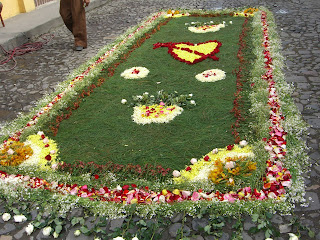
Flowers on the street


After watching the procession, we went back to the Plaza de la Merced, and had tacos. I had carne adobado, and the kids had chorizo tacos. They were quite good. It was getting late, and we decided to make a final stop in Pollo Campero to have a beer and use the clean restrooms before heading back to Guatemala City. Getting the kids off of the playset in the Pollo Campero wasn’t easy, but we eventually succeeded.

When we made it to the bus stop where the buses leave for Guatemala City, there was a bus leaving. It was standing room only, so we decided to wait for the next bus. This meant we got seats, but had to wait until it filled up.

We finally got to Guatemala City at 8pm. It was dark, and the bus let us off in the middle of the road. Luckily, we found a taxi, and made it safely back to our apartment.

August 17, 2009

How hard can it be to get the kids in school in Guatemala City?

Bright and early this morning, we took our three kids to a nearby school to enroll them. The teacher and the principal were very welcoming and told us about all of the benefits of their school. We agreed that we would like to enroll the kids in the school. It would cost us $200 per kid a month, $600 overall, but we decided that was probably our best option. The American School in Guatemala costs much more, and has a several thousand dollar enrollment fee. Public school seems not to be an option, because of the kind of visas we have.

Nando and I left Tatiana and Soraya at the school, and took Raymi with us. The principal explained that Raymi’s teacher was out sick, and that Raymi should meet her teacher on her first day. So, it would be better for Raymi to start the following day when her teacher was back. Raymi was quite disappointed, but we appeased her by telling her we would buy her some new shoes for school at the store. The kids have been running around in sandals, and it is a bit colder here than in Jamaica.

Nando, Raymi and I went on a shopping spree to get snacks and other things for the kids to take to school, as well as new tennis shoes for Raymi. After that, we came home and had lunch, and at 2pm, Nando went to pick up the girls.

Around 3pm, I got a call from the school. The principal told me that, she was sorry, but she didn’t think it was a good idea that the girls enroll in their school. Wow! I couldn’t believe that they wouldn’t want the extra money. According to the principal, Tatiana and Soraya are at the right level in math, but are behind in Spanish language reading and writing. (Here, they teach kids cursive first, and the kids read more English than Spanish, so that wasn’t a surprise.) She also said that the school year is nearly over, so it doesn’t make much sense. Finally, she pointed out that Tatiana and Soraya are restless. (She has a point there.)

In all, after spending the morning getting the girls into school, we find out that we are back at square one. Well, not exactly, the principal recommended another school to me, one that has the US calendar, and should be starting up right about now. I gave them a call, and they said they would let me know if there is space for the kids. Unlike the other school, it is not in walking distance. And, it may be more expensive. They didn’t want to give me the price over the phone. I imagine that means it’s not cheap.

Thinking about how much we will have to spend on school fees, it occurred to me that $600 per month is likely quite a bit more than a teacher earns in Guatemala. In Peru, teachers earn $200 per month, and it seems as though the prices in Guatemala and Peru are about the same. The minimum wage in Guatemala is about $150, so I would guess teachers earn about $300. One online forum I read indicated that teachers start out at about $200 a month, and max out around $600 after twenty years of service. All that to say we likely can afford a private teacher.

As I was thinking about this, la señora, the owner of our apartment, came over to ask me about the school, and to offer her suggestion that we hire a teacher. She apparently did the math as well, and insisted it would be less expensive to hire a teacher. The idea sounds attractive, but there are some drawbacks.

One of the major drawbacks is the lack of contact with other children. If we hire a private teacher, it will be just the three of them. I suppose one solution would be to use the money we save by hiring a teacher to enroll the kids in some sort of dance, music, or art classes. There, they might be able to meet other kids. Only issue with that is that Tatiana just told me she wants to take gymnastics, Soraya, Kung Fu, and Raymi, ballet. That could get a bit complicated.

I just found a website with kids’ activities in Guatemala City. http://www.laguiadeguate.com/public_laguiadeguate/?MainSection=categorias&cat_id=289 This has lots of options! Perhaps we could take the girls to see the martial arts and gymnastics places to see which one they prefer. The gymnastics place offers a free class. We just have to make an appointment. Sounds like a plan!

August 13, 2009

San Francisco to Miami to Guatemala – Planes, Trains and Airport Shuttles

On the plane traveling from San Francisco to Miami, I began reflecting on my rather convoluted travel plans. I flew from Kingston to Miami on the morning of August 6, and then from Miami to San Francisco that evening.

My first night in San Francisco, I stayed at a hotel near the airport. That worked out pretty well. I took the shuttle to the hotel where I was staying – the Howard Johnson in San Bruno. The hotel was actually quite clean and comfortable. At $60 a night, with free wireless, breakfast, and an airport shuttle all included, it was quite a bargain. I woke up early on August 7, took the airport shuttle back to the airport, and got the BART into Berkeley. That took a couple of hours, but I arrived at the conference right on time.

I had my carry-on luggage with me, and went straight from Berkeley to my hotel in downtown San Francisco, where I was sharing a room at the Metropolis Hotel. The Metropolis was a nice hotel, with friendly staff and attractive decor. Two of the perks are free coffee in the morning and free wine in the evening. The beds were also very comfortable. It was a bit more pricey than the Howard Johnson, but I managed to pay about the same by sharing a room with two other women. As I spent little time in the hotel room, that worked out quite well.

Once the conference was over on the afternoon of August 11, I took the BART back to the airport, and took a shuttle to my hotel by the airport. This time I stayed at Citi Gardens Hotel. It was a little less nice than the Howard Johnson at San Bruno, but closer to the airport, and certainly passable. I particularly liked the modern implements in the bathroom and the nice green space of the hotel. I woke up in the morning, had the free breakfast, and took the free airport shuttle back to the airport.

On August 12, I spent the night in Miami before flying to Guatemala the next day. Taking my time this way allowed me to save money in addition to taking things slowly and resting quite a bit. The drawback has been how long it will take me to actually arrive in Guatemala. Had I taken a red eye to Miami on August 11, I could have flown to Guatemala on August 12, and gotten there a full day beforehand. Of course, I would have arrived completely exhausted, as it is never really possible to get a good night's sleep on a red eye, especially one that is only five hours.

Instead, I had about ten hours of sleep on a comfortable bed in San Francisco and arrived in Miami fully rested. My plane landed at 9:30pm, and I made it to the hotel before 10pm. I was very lucky, as the shuttle was waiting for me at the airport. It took about five minutes to get to the Days Inn Airport North. The hotel, again, was decent. My room was super large, and was right next to the pool and the garden.

I arrived with an empty stomach, and was pleased to hear there was a Peruvian restaurant, Peru Place, three blocks from the airport. When I got to the restaurant, there was a soccer match between Costa Rica and Honduras, and the place was packed. The hostess told me they were charging entry because of the game, but she let me in to place a to-go order.

I looked around the restaurant and realized that the place was filled with Costa Ricans. When I asked a gentleman about it, he told me the Hondurans were at the restaurant next door. Who knows how they worked it out that the Costa Ricans would be at the Peruvian restaurant and the Hondurans at the Latin American restaurant, but it was something probably unique to Miami, or other global cities. For me, it made a simple trip to get something to eat much more interesting.

Back at the hotel with my pollo a la brasa, I found out that the hotel shuttle will drop me off at the Tri-Rail, which is the train I need to take to get to the Fort Lauderdale airport in the morning. This is all working out better than I expected. The airport shuttle leaves on the hour, so I can get the 7am shuttle to take the 7:39am Tri-Rail.

I arrive in Guatemala around 11:30 am on August 13. I will see my husband and kids for the first time in a week. I can't wait to see them. I am sure the kids will be unkempt, but I might be pleasantly surprised, as Tatiana and Soraya are getting better at brushing their own hair. I braided their hair into little braids before I left, but I can't be sure that will have lasted this long.

Funny that their hair would be on my mind. I suppose there are all other kinds of things I could be worried about with Nando and the kids in Guatemala City for the first time. Actually, Nando, the twins, and I were in Guatemala City in 2002, but just for a day. We spent three weeks traveling around Guatemala, and made a stop in the capital. In any event, Nando is quite resourceful, and I bet he has traveled all around the city with the girls, even though that can be challenging.

We have barely spoken since I left Miami. Nando called me when he boarded the plane to Guatemala on Sunday to let me know the plane was about to take off. And, I called our rental agent on Sunday afternoon to ask her if Nando had arrived. She assured me he had. Other than that, we have had no communication. I arrive in Guatemala City on the afternoon of August 13th, and will take a taxi to our apartment. Hopefully Nando and the girls will be there to let me in. If not, I will sit my well-rested self down and wait.

August 9, 2009

Travel, Conferences, and San Francisco

Writing has become, for me, a habit. This means, on the one hand, that it is a hard to stop writing. On the other, it means that once I stop, it does not seem as easy to pick it up. It has been several days since I have written, and it is hard to just jump into it. However, experience tells me it will happen if I just do it, so here I am, typing away.

Since I last posted, I have been lots of places. I had a three day trip to Montego Bay where I met deportees, other contacts, and found a place to stay next summer – a condo overlooking the beach! I also spent some time on some of Montego Bay's absolutely beautiful beaches. Unfortunately, I returned to Kingston with an awful sore throat and painful ear. Even worse, I had only two days to wrap things up in Kingston, pack, and prepare to get my family to Miami and myself to San Francisco.

Miraculously, and with an abundance of help from my husband, we were able to get our apartment cleaned, our bags packed, and ourselves on the plane to Miami. We made it to the airport on time, and, after relieving our bags of the excess pounds, had no trouble checking in. We even had time to sit down and have breakfast before boarding. Even more amazing, as we were eating breakfast, an older woman approached us and complimented my girls on their good behavior! That was a first!! Usually, we get disparaging looks from folks who don't like to hear or see children. But, this lovely woman from St Louis was kind enough to come over to us and tell us how much she admired how well the children were behaving. Perhaps she didn't notice them playing tag when we were waiting in line to check in. Nevertheless, that set a nice tone for the day.

My husband, Nando, and my three daughters will spend three days in Miami before heading to Guatemala, while I go to a conference in San Francisco. Once in Miami, Nando's brother picked us up and took us to the Ocean Surf Hotel, where Nando is staying with the girls. Before leaving them, I got to spend some last few moments on Miami Beach. At 8pm, I caught my flight to San Francisco for a conference, the American Sociological Association Annual Meeting. After a five and a half hour flight, I made it to a hotel close to the airport, where, with the help of some antihistamines, I had a good night's rest. I woke up early to take the train into town for a preliminary conference in Berkeley.

At first, the conference was a bit of a culture shock. After hanging out with my family and doing research in Kingston, it was a bit of an adjustment to be in a room full of sociologists, where I was supposed to be networking and talking in academic-ese. I was very glad to see a friend of mine, Jessica, as I knew I could be myself with her. Nevertheless, I was surprised at how quickly I was able to get back into the groove. This was made substantially easier by the fact that everyone was quite friendly.

The preliminary conference was called “Making Connections,” and was organized by the International Migration Section of the ASA. These specialized conferences tend to be friendlier and easier to navigate than big, disciplinary ones. In addition, the international migration scholars were very friendly. People who sat next to me extended their hands in greeting and smiled. This level of friendliness is not always the norm in a roomful of PhDs, so I was pleasantly surprised.

At the end of the day, however, I was exhausted. I came to my hotel room in downtown San Francisco with my room mate, Wendy, and tried not to fall asleep, as it was only 8pm. Wendy and I chatted about the ups and downs of our jobs, and I was able to stay awake until 9:30pm. I managed to stay asleep most of the night until 6am, when I really couldn't sleep anymore.

I got up and got ready to conference again. (For us academics, yes, “to conference” is a verb.) I went to two sessions on transnationalism, which is a subfield my work on deportations is engaging with. I also ran into tons of people I haven't seen since last year's conference, or since I left Kansas in May.

I am debating with myself how much I want to take advantage of my time here and enjoy San Francisco. Despite two nights of rest, I am still exhausted from all of the travel. But, the weather has been gorgeous here, and it would be a shame to waste all of this sunshine we have been seeing.

Hopefully, I will be able to get a good night's rest tonight. I am a bit nervous, as Nando is flying to Guatemala first thing tomorrow morning with the girls! I am hoping he has no problem getting out of the country or getting into Guatemala! Really, there should be no problem, but the potential for things not going right worries me. I asked Nando to call me as soon as he gets into the waiting area to get on the plane tomorrow, and again once he gets to Guatemala. Hopefully, by this time tomorrow, I will have nothing to worry about.